What Investors Really Want: A Plan for Bear Markets

What Investors Really Want: A Plan for Bear Markets

In this short video, Brad Pappas, founder of Rocky Mountain Humane Investing, explains why now is the time to play both offense and defense with your investment strategy. If you’re worried about losing the gains you worked hard for—or putting your retirement lifestyle at risk—this message is for you.

Transcript:

Introduction to Rocky Mountain Humane Investing

Hello again, I’m Brad Pappas, founder of Rocky Mountain Humane Investing, a fee-only investment advisor with clients throughout the U.S.

Don’t Believe the Hype: Investors Are Not Helpless

It’s Saturday, April 5th, and I’m really bothered by the media depicting investors as being helpless in this market crash. You do have alternatives. I can imagine that if you’re new to us, you might be thinking that we’re just about social issues.

A Strategic, Data-Driven Investment Process

We also have a data-driven strategic process as well. It’s been a constant goal of mine to improve our investment process. To use a football analogy, we play both offense and defense for client accounts.

Why Preservation Matters in a Bear Market

Our goal is to do well in a bull market and then go into a preservation mode in bear markets. As of April 4th, the Humane Growth Portfolio, which is the model for our clients, is down just 1.7%. Preservation is critical if you want to keep the profits made in a bull market. For many, the returns made in 2024 have already been evaporated.

Why Retail Investors Can’t Copy Warren Buffett

In my view, the retail investor is being told by the majority of advisors to act like a Warren Buffett. But the average retail investor is not like Mr. Buffett at all. We’re not billionaires, and he does not rely on a Berkshire Hathaway 401(k) plan for retirement.

A 40% market decline will affect your retirement standard of living. Plus, after a 40% decline, you’ll need a 68% return to reach your high watermark again, and that could take many years. But your account statement does not have to be an obituary of the life you hope to live in retirement.

Talk to a Strategic Investment Advisor

So if you talk to your advisor and you don’t feel you’re receiving enough strategic help, you might want to give us a call. If you did, these are some of the facts we would discuss with you. We only focus on long-term trends, which are defined by years—not days or months.

Spotting Market Shifts Early in 2024

We identified a probable change in trend in January, and especially in February of this year. Our clients are heavily invested in cash and treasuries. Speaking for my clients, I don’t want to give the profits back from previous years.

What You Need to Know About Bear Markets

Here are some facts about bear markets: They’re rarely quick events, and patience is critical. Lots of pundits will declare that the market has bottomed, but we only know in hindsight, and we don’t make those silly kinds of projections.

The average bear market lasts nine months. Since 2000, we’ve had two bear markets that have lasted much longer. The peak to trough in 2000 to 2002 was a loss of 49%. The peak to trough in 2007 to 2009 was a loss of 56%.

For perspective, as of April 4th, we’re only in month three of the decline. If we enter a recession, which seems increasingly likely, we’ll probably decline further.

Are You Gambling on a Quick Recovery?

Now do you really want to gamble that this bear market will not be like 2002 or 2008? If you’re wrong, your account will be decimated. It’ll take many years to recover—if you’re successful. Many investors quit at this point.

Protecting IRA Portfolios Without the Tax Burden

If your investment portfolio is an IRA, it’s an easy decision since taxes are ignored. We do our best to protect our client assets, but it can never be considered a guarantee. Our systems are not designed to get you out at the absolute top, nor buy in at the absolute bottom.

How to Get in Touch

If you’re ready to schedule a meeting, you can call us at 970-222-2592 or send an email to brad@greeninvestment.com. Thank you.
Essential Steps to Safeguard Your Assets in a Market Crash

Essential Steps to Safeguard Your Assets in a Market Crash

Most investment firms will tell you to just “ride out the storm” when the market drops—but is that really the best approach?

In this video, Brad Pappas breaks down how bear markets can impact your long-term financial success and why proactive investors can take steps to mitigate risk before the downturn hits. If you’re nearing retirement or simply want to safeguard your investments, this is a must-watch.

Transcript:

Introduction to Rocky Mountain Humane Investing

Hello, I’m Brad Pappas, founder of Rocky Mountain Humane Investing, a fee-only investment advisor with clients throughout the United States.

The Reality of Bear Markets

I want to address an issue that is paramount to individual investors today: how to cope and plan around a sudden bear market, where major indices fall by at least 20% or more. As an independent firm with client assets at Charles Schwab, we take a proactive approach to protecting client assets from extreme declines.

The Devastating Impact of Market Declines

Extreme declines can be disastrous for your retirement plan and future standard of living. How you handle these periods represents the single biggest challenge to your long-term financial success.

Misleading Advice from Large Investment Firms

If you are an investor with one of the large mutual fund complexes, you may be told that market timing is impossible and that you should stay invested for the long term. These statements are misleading. While short-term market timing is nearly impossible, longer-term strategic adjustments are achievable. Large firms managing billions of dollars have limited ability to raise cash or be defensive, meaning they often fail to adjust for high-risk markets.

The Importance of Investor Responsibility

For better or worse, it is the investor’s responsibility to protect their own assets. Many retail investors fall into the trap of recency bias—assuming that because their investments have performed well in recent years, they will continue to do so. This mindset is based on hope rather than reality.

A Real-World Example: The Impact of a Bear Market

Imagine you are a 55-year-old investor about to experience a 30% stock market decline with $500,000 at risk. Most bear markets take over a year to unfold, meaning you not only lose money but also time. After a year, your principal could drop to $350,000. To recover, you would need a 41% return just to break even. This typically requires at least two consecutive years of nearly 20% gains. By the time this recovery happens, you could be 58 years old, having spent three years with no financial progress.

The Flaws of the Buy-and-Hold Strategy

Many investors relying on a buy-and-hold strategy face this predicament as they approach retirement. Instead, proactive investment planning can help mitigate these risks.

A Better Approach to Protecting Your Assets

We implement a strategic plan that is not reactive but proactive, ensuring protection during bear markets without engaging in short-term trading. This approach provides several key benefits:

  • Reduced Anxiety: You won’t need to constantly monitor financial news or check your portfolio balance.
  • Lower Risk Exposure: During bear markets, we shift assets primarily into treasuries to preserve capital.
  • Preparedness for the Next Bull Market: RMHI clients are positioned to capitalize on new market opportunities rather than recover from losses.

Important Considerations and Disclosures

As required by my compliance department, I must emphasize that there are no guarantees in investing. While we strive to protect client assets, no strategy can ensure absolute protection. Our approach is not designed to predict market tops or bottoms perfectly.

Schedule a Consultation

If you’re ready to discuss how we can help safeguard your investments, you can call me at 970-222-2592 or email me at brad@greeninvestment.com.

RMHI Client Letter, March 2025

Curbing Our Enthusiasm

This past December and January I became quite concerned that a significant market top was forming in US stocks. This was quite a change since I’d been positive for over the past two years.

RMHI manages client assets with a process designed to reduct risk and preserve account valuations when the odds are high for a significant market decline. Alternatively, we increase stock exposure when markets begin to show positive trends. We are not short term oriented and our ideal is to own a core group of stocks during an entire cyclical bull market run.

I recently was talking to my realtor as we are in the process of selling our home in Allenspark. He told me that he began to buy stocks in the early 1980’s and has never sold any since. I complimented him but told him that he is the exception to the rule. The average investor eventually reaches a level of fear then panics and sells during periods of great stress in declining markets. This is not a plan but a reaction that leads to eventual failure if done repeatedly.

Our process is in place to increase the odds of investor success by protecting their account values during major market turns. I want everyone to be a success story.

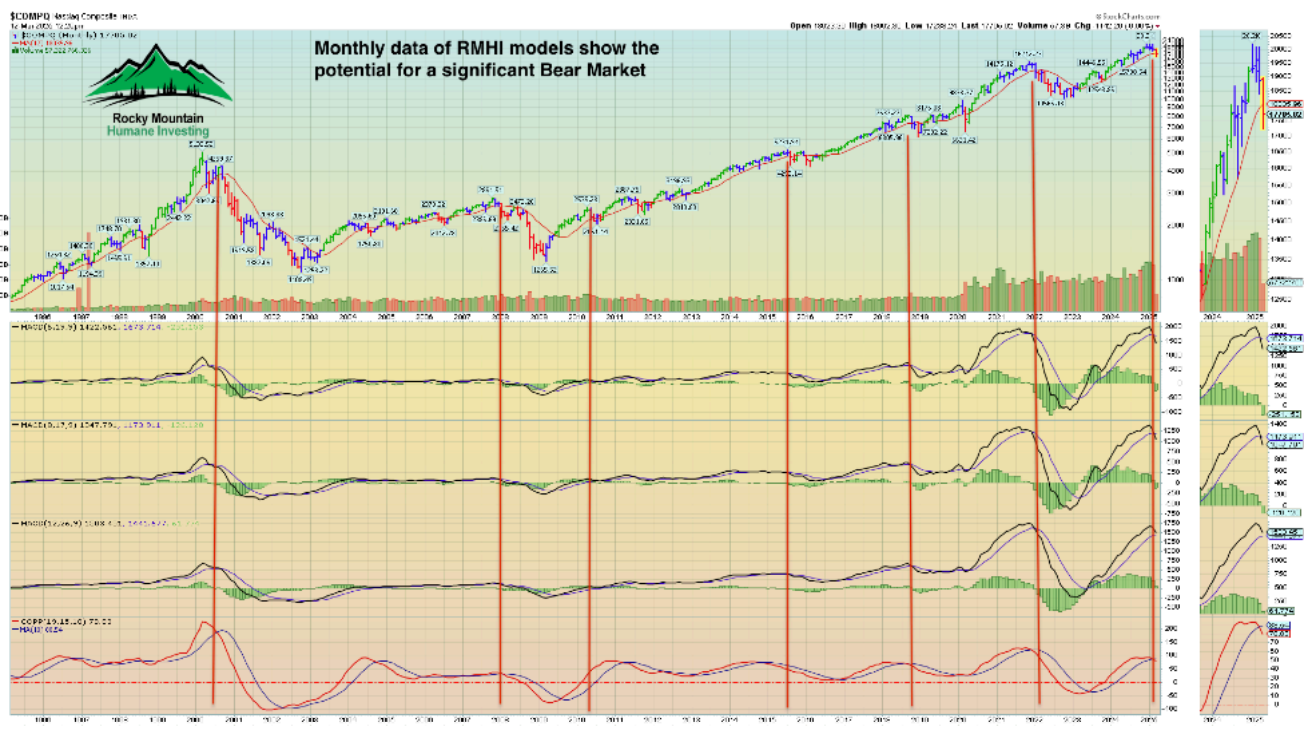
Based on my data I believe US markets are in the midst of potential 25%-30% decline. My slow moving monthly models have turned negative. It will take several months for them to turn positive so patience is very important. The average Bear market for stocks is approximately 9+ months. In other words, based on my data I don’t think this is a garden variety market selloff.

Markets and investors need a sense of stability going forward. Obviously this is not the case at present. My guess is that markets are discounting a future of instability and irrational behavior from Trump.

At present we have sharply reduced our equity exposure: Spotify, Broadcom, Cintas, Arista, FICO, Microsoft, Nvidia, Comfort Systems, Meta, Moody’s, Mastercard and Vertiv Holdings have been sold. We remain holders of: Constellation Software.

We have approximately 9% exposure to stocks. The only additions have been an increase in US Treasuries and Gold in client accounts. Gold is a hedge against currency devaluation in the USD. Plus, an ancient form of currency during crisis.

Bitcoin is rapidly losing its potential and reputation except to the zealots. The manipulation by the new administration is so plainly obvious. Bitcoin is a risk asset and has not shown an ability to hold value during market duress. Bitcoin promoters like Michael Taylor of Microstrategy only offer self-serving cheerleading opinions to bring in new buyers.

What strikes me is how deliberate this potential economic downturn is being generated. It’s a deliberate trashing of the economy. The administration is gaslighting the effects of Tariff’s, as it is plainly a tax. A tax that is inevitably paid by the consumer and not the “government”. 

Its my belief that the combination of austerity measures being enacted by the current President: DOGE, Federal employee layoffs, Tariff’s plus reciprocal Tariff’s, deportations will create a slowdown in growth for the US economy.

These are amongst the most cruel ways to reduce inflation. It appears they want to slow demand in the economy by reducing federal benefits and increasing federal unemployment. These benefits would include federal employment (DOGE) plus cutting Medicare, food assistance and low income housing. 

I do not believe they’re considering or care about the impact of the increased strain on basic assistance programs (which are being cut) which are in place to support the lowest levels of society.

Meanwhile there will be tax cuts, reduced IRS oversight and deregulation.

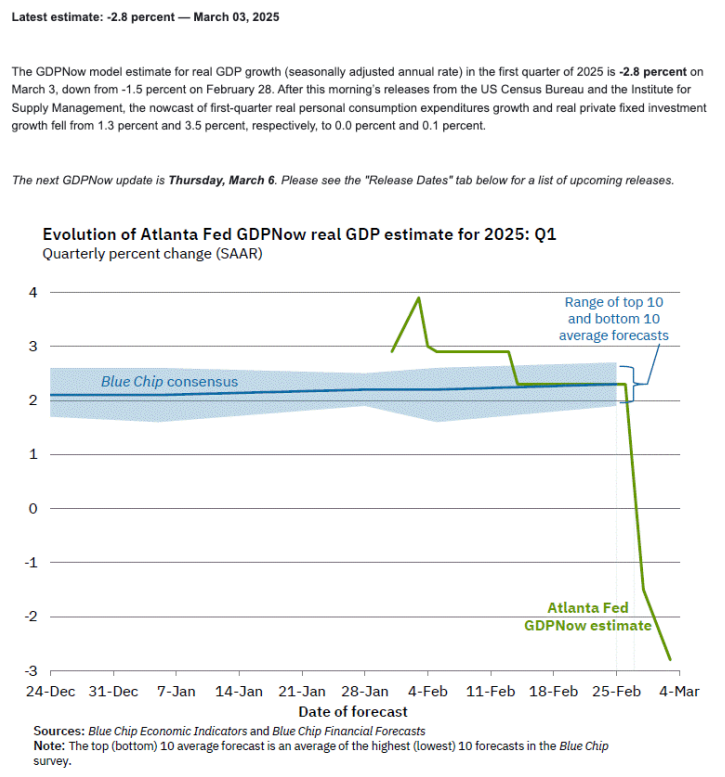
Four weeks ago the GDPNow forecast was +3.9%. Two weeks ago it was +2.3%. There has to be a certain level of genius to inherit a healthy economy growing between 2% and 3% and plunge to negative growth.

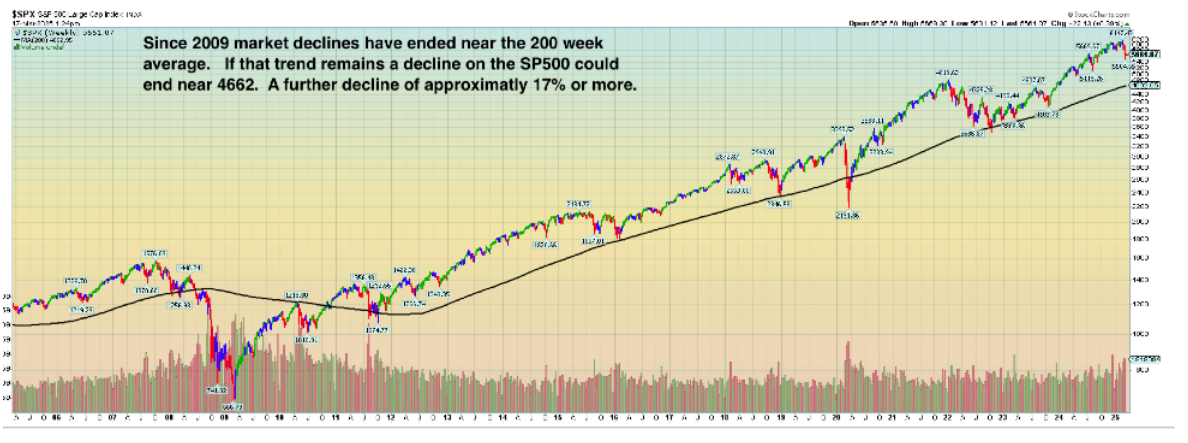
How far a market declines is anyone’s guess. Previous post 2008-09 declines fell to the 200 week moving average for the S&P 500. That would imply a further 17% decline from here.

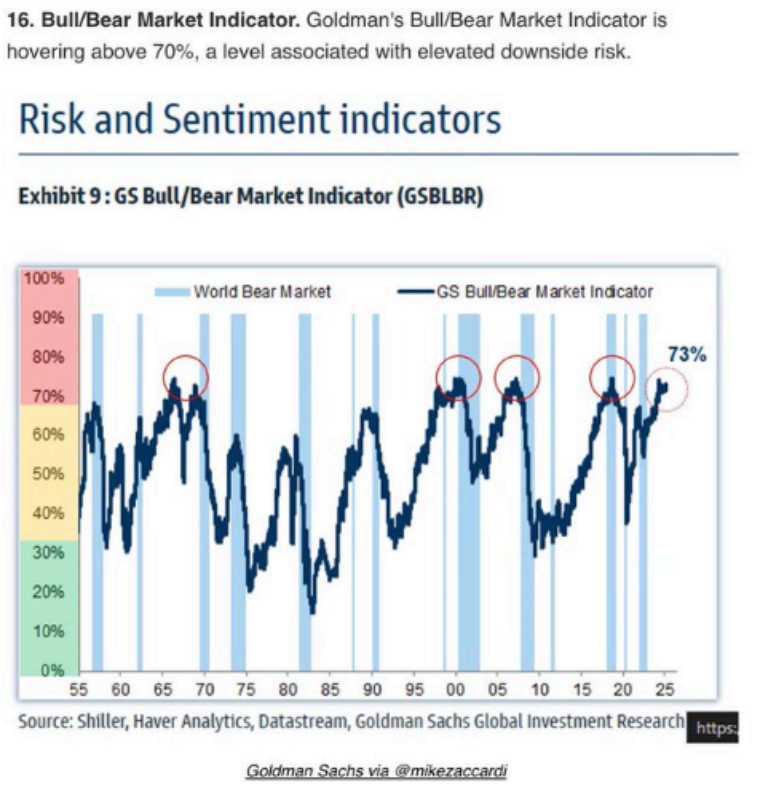
Goldman Sachs Bull/Bear Indicator is not a timing mechanism but an indication of risk. Stocks are not cheap and there is a disproportionate balance between upside potential and downside risk.

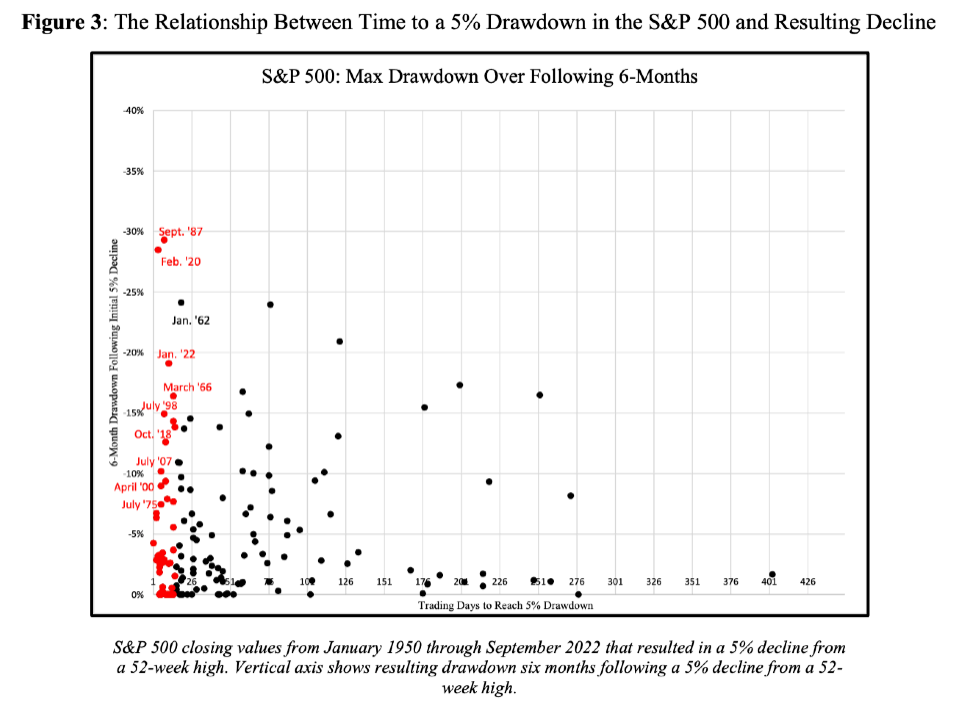
Further evidence of the degree of risk and odds of a significant market decline come from 2023 Charles H. Dow Award Winner Andrew Thrasher, CMT and his “The 5% Canary” study. Canary referring to an early warning indicator.

Thrasher found significant evidence of the relationship between the speed of an initial market decline of 5% and the propensity for much larger declines. In other words, a 5% in 15 days or less led generally led to larger losses going forward.

Red dots in the chart above met the Canary criteria. Fast declines led to predictably increasing losses. Our recent decline met the 5% Canary criteria which predicts more declines to come.

Thank you for reading

Brad Pappas
March 18, 2025

Disclaimer: The purpose of this letter is solely for the dissemination of information investment products or services. Investment advice or the rendering of investment advice for compensation will not be made absent of compliance with the state investment advisor requirements. For information concerning the compliance status or disciplinary
history of advisor or firm the consumer should connate their state securities law administration. 

The information contained in this letter and email should not be construed as a financial or investment advice for any subject matter. Rocky Mountain Humane Investing, Corp. expressly disclaims all liability in respect to actions taken based on or any of the information on this email.

As always, past performance is no guarantee of future success or returns. In fact future returns may be negative or unprofitable. Accounts managed by RMHI are not diversified. Meaning they own less companies than a diversified fund. Thus the portfolios may be more exposed to individual stock volatility than a diversified fund.

You’ve Inherited Money, Now What Should You Do?

You’ve Inherited Money, Now What Should You Do?

Receiving an inheritance can be a significant life event, often accompanied by a mix of emotions and financial considerations. As an investment advisor, I understand the importance of making informed decisions when managing newfound wealth.

In this short video, I walk you through some key steps to help you make thoughtful decisions about your inheritance, honor your loved one’s legacy, and align it with your financial goals.

Transcript:

Understanding the Complexities of Inheriting Money

Hi, I’m Brad Pappas, an investment advisor at Rocky Mountain Humane Investing.
I want to spend a few moments today talking about inheriting money because inheriting money can be more complex for new investors than you might think. While you might have good intentions, it’s easy to overlook things, especially when you’re grieving.

Take Time to Process Your Loss Before Making Financial Decisions

So if you’ve received an inheritance or anticipate receiving one, here are some things to consider.
My first suggestion is to take a period of time to process the loss before making decisions about the money. Initial ideas are usually influenced by emotions, so give yourself some time to think and plan.

Honoring Your Loved One’s Legacy Through Smart Financial Choices

Your loved one likely spent their lifetime building their wealth. They probably hope you’d make some wise decisions and overcome the initial temptation to splurge. In other words, take care of your own emotions to safeguard the wealth they’ve gifted to you.

Understanding the Type of Inheritance You’ve Received

Next, it’s critical to understand the type of inheritance you’ve received. How do you access the funds? Are there any taxes associated with it? And what are your options going forward? Here’s a realistic scenario.

Practical Ways to Use Your Inheritance Wisely

Your inheritance came in the form of cash.
You could use a portion of it to pay off bills. Afterwards, you could establish a retirement account or pay down your mortgage or put down a deposit for a home. If you have children, establish college savings accounts.

Balancing Enjoyment with Long-Term Financial Planning

Finally, after more pressing needs have been addressed, maybe it’s time to take that dream vacation you’ve been planning and then decide to solidify your future with an investment account.

The Value of Working with a Fiduciary Investment Advisor

At this point, it’s smart to reach out to help with an investment advisor who has fiduciary responsibility. If you’re ready to schedule a meeting, you can call me at 970-222-2592 or send an email to brad@greeninvestment.com. Thank you.
Maximizing Tax Efficiency in Cruelty-Free Investing: Strategies for 2025

Maximizing Tax Efficiency in Cruelty-Free Investing: Strategies for 2025

More investors are looking for ways to support cruelty-free companies. How can they follow their consciences while maximizing tax efficiency? This video offers some ideas on how to take positive steps that benefit all sides.

Transcript:

Why More Investors Are Avoiding Certain Companies

Today’s investors have different reasons for avoiding certain industries than previous generations. Ethical investing has evolved, incorporating concerns about animal welfare, the environment, and human rights.

The Origins of Animal Cruelty Screens in Investing

In the early 90s, while rescuing dogs, I created the first animal cruelty screen. This approach has since expanded to include additional social and environmental considerations.

Aligning Investments with Your Beliefs

Many investors want to avoid companies that conflict with their values. For taxable investors, it’s also crucial to incorporate tax-efficient strategies. In this video, I’ll explain how we blend social screening with tax efficiency.

What Does Cruelty-Free Investing Exclude?

We avoid investments in:

  • Factory farm companies
  •  Companies that conduct animal testing (biotech, pharmaceuticals)
  •  Food and leather retailers (supermarkets, shoe retailers)
  •  Oil and mining companies

Are You Missing Out on Profitable Investments?

The industries we screen out often have:

  •  Low profit margins
  • Slow or no free cash flow growth

By avoiding these industries, you’re not necessarily sacrificing strong financial returns.

Long-Term Investing for Tax Efficiency

The best way to minimize taxes on profitable investments in taxable accounts? Never sell. However, most stocks are too volatile for a true buy-and-hold strategy.

The Key to Sustainable Investing: High-Quality Stocks

We focus on companies with:

  • Protective moats and barriers to entry
  • Decades-long lifespans
  • Consistent capital and free cash flow growth

Balancing Risk and Return for Long-Term Growth

Studies by Morningstar and others show that investing in high-quality stocks is one of the best ways to manage risk while maximizing returns. We prioritize companies that demonstrate steady, year-over-year growth.

Examples of Strong, Ethical Investments

FICO and Cintas are great examples of consistent, high-quality investments that align with our strategy.

Using Charitable Giving for Tax Efficiency

Donating shares of low-cost-basis stocks to a qualified charity helps investors:

  • Avoid capital gains tax
  • Potentially receive a tax deduction if they itemize deductions

Work with a Qualified Advisor for a Tailored Strategy

Considering socially responsible investing? A qualified investment advisor can:

  • Define investments that align with your values
  • Maximize tax efficiency
  • Make strategic year-end or mid-year portfolio adjustments

Final Thoughts

If you’re looking to invest ethically without sacrificing returns, an expert advisor can help you make informed, tax-efficient decisions. Thank you.